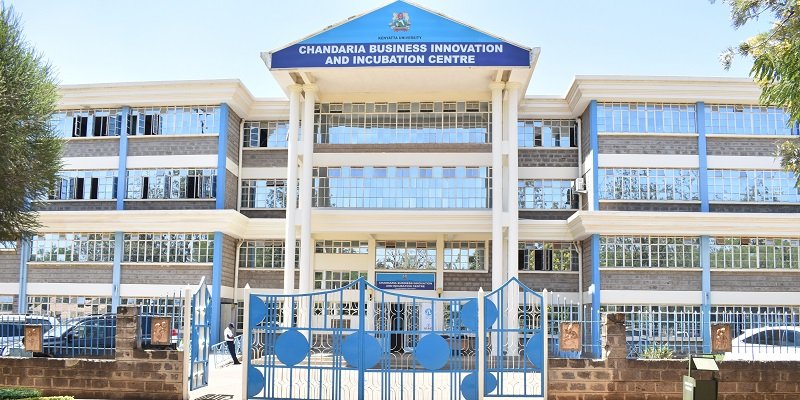
Chandaria Business Innovation & Incubation Centre · Open 8am to 5pm

What we offer in the incubation hub.

3D Printing

Create physical prototypes with desktop 3D printers.

ICT Facilities

Access modern ICT tools for innovation and learning.

Training Services

Enhance skills with professional training programs.

Mentoring Programmes

Assistance with business basics....

Prototyping Support

The Center supports innovators to acce...

Marketing & Exhibition Support

Innovators with prototypes and minimum viabl......

Management of Intellectual Property

The Technology Transfer Office (TTO) is respon....

Technology Valuation

The Technology Transfer Office assists in determini....

Technology licensing

The Technology Transfer Office facilitates agre.....

Technology and Innovation Support centre

The Technology and Innovation Support Centre (TISC) program provides innovators in Kenya with access to...

3D Printing

The Centre has in place desktop 3D printers that innovators can use to produce physical prototypes of their engineering design projects. Innovators are able to produce one-offs from Computer Aided Designs (CAD) cost-effectively and quickly. The four 3D printers include 2 Flashforge Creator Pro and 1 Flashforge Dreamer printer (these are fused Deposition Modeling (FDM) printers that extrude thermoplastic materials such as PLA, ABS through a heated nozzle), and a Peopoly Phenom L which is a resin based masked stereolithography (MSLA) printer. We conduct training and demonstration on 3D printing to KU students on request. If you need this service please contact our IT expert Ken Maina at email: kennedy.gathanga@ku.ac.ke and Ext 3898.

Technology Transfer Office

The core role of the Technology Transfer Service(TTS) at the centre is to assist faculty, researchers, technicians and students in managing their intellectual assets in ways that facilitate their transformations into benefits for society. In doing this, the TTS helps to bridge the gap between research and innovation. The general role is defined into more specific ones that include:

  • Establishing relationships with firms and community actors
  • Generating new funding support from sponsored research or consulting opportunities
  • Providing assistance on all areas related to entrepreneurship and intellectual property (IP)
  • Facilitating the formation of university-connected companies utilising university’s technology (start-up) and/or university people (spin-off) to enhance prospects of further development and,
  • Generating net royalties to the university and collaborating partners.

In order to accomplish the above assigned roles, the Technology Transfer Office carries out a very variable range of activities relating to different channels of knowledge and technology transfer that involve a contract between the university and a third party. These channels; collaborative research, contract research, consultancy, spin-off and start-up companies, incubator facilities, licensing and patenting

Intellectual Property Technology Licensing Valuation & Marketing Patent Drafting Tech & Innovation Support Tech & Innovation Support

The Technology and innovation support centre (TISC) program provides innovators in Kenya with access to locally based, high quality technology information and related services, helping them to exploit their innovative potential and to create, protect and manage their intellectual property (IP) rights.Services offered by the TISC include:Access to online patent and non-patent (scientific and technical) resources and IP-related publications.Assistance in searching and retrieving technology information Training in database search On-demand searches (novelty, state-of-the-art and infringement)Monitoring technology and competitors Basic information on industrial property laws, management and strategy, and technology commercialization and marketing.

Technology Transfer Office

Partnerships and Collaborations For Innovation and Entrepreneurships

The Chandaria Innovation Center facilitates the development of strategic partnerships and collaborations specifically targeted to enhance innovation and business development. Of great interest are relationships with industry actors, entrepreneurs and investors who can provide an effective pathway for technology transfer through commercialization. Industry collaborations are critical for Skills development (education and training), generation, acquisition, and adoption of knowledge (innovation and technology transfer) and promotion of entrepreneurship (start-ups and spin-offs). The Center supports partnerships development through:

  1. Providing a domicile for innovators and start-ups where potential partners can locate them;
  2. Issuing introductory letters to innovators as they engage potential partners;
  3. Acting as guarantor and assurance to partners that resources will be used effectively and commitments honoured.

Industry links enable bi-directional flow and exchange of knowledge, skills, innovations and technologies for the mutual benefit of university and industry. Industry collaborations enhance the relevance of research carried out in Kenyatta University and foster the commercialization of research outputs. We aim to increase the mobility of expertise between Kenyatta University and industry while industry will benefit through increased access to new products and technologies.

Partnerships and Collaborations For Innovation and Entrepreneurships

Maker Space and Light Manufacturing Facility

Kenyatta University received a grant of KShs. 90 Million for a Maker Space and Light Manufacturing Facility. It will be a paradise for makers that will entail high-tech workshop open to the public, which provides members with access to machines, tools and software as well as a creative community. With the new launch of Maker Space, Chandaria BIIC will cater to ambitious start-ups, active doers and creatives. It will offer a place to implement ideas and innovations in the form of prototypes and small batch production. Various work areas will be available, such as machine, metal and woodworking shops as well as textile and electrical processing facilities. In addition, 3D printers and laser and water jet cutters will make it possible to fabricate new shapes and to process every type of material. The Maker Space will offer training and consulting services as well as events for members with any level of knowledge, providing them with support and networking options.

How incubation works →